


October 5: Saint Maria Faustina Kowalska
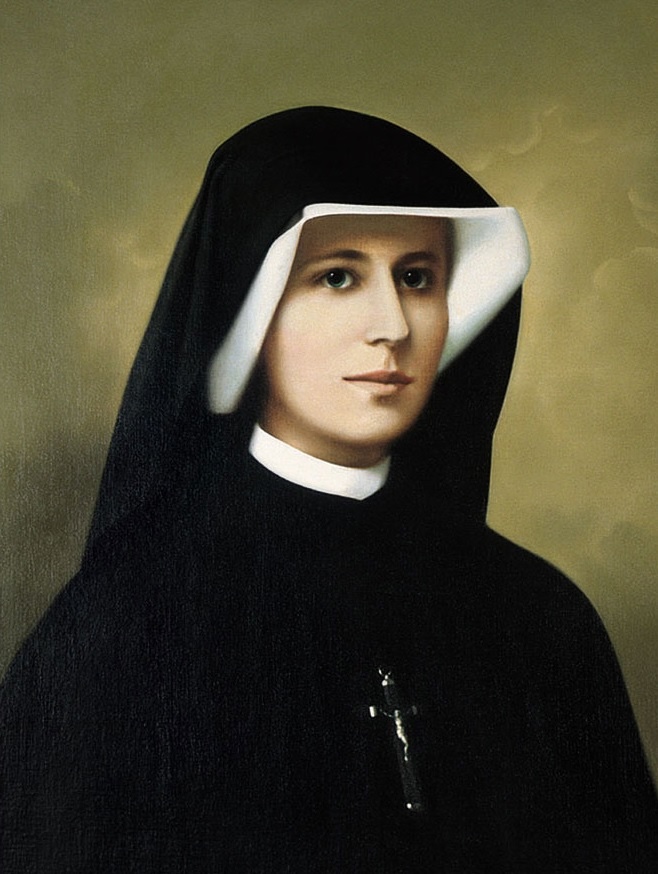

Messenger of the Mercy of God
Known as the Apostle of Divine Mercy and Teacher of the Interior Life, Saint Faustina Kowalska is one of the most significant spiritual figures of the 20th century, loved throughout the world for the mystical depth of her experience and for her mission in the history of the Church.
Born on August 25, 1905, in the Polish village of Głogowiec, she was the third of ten children of a humble farming family. Her parents were Marianna and Stanisław Kowalski. She was baptized two days after her birth in the parish of Świnice Warckie, receiving the name Helena. At the age of nine, she received her First Communion and although she was able to attend school for only a few years, she was deeply attuned to the things of God from an early age. She felt called to religious life at the age of seven, but her parents, struggling financially, initially prevented her from entering a convent.
At the age of 19, prompted by a vision of the suffering Christ, she left home and moved to Warsaw where she sought a religious community willing to accept her. After a year of working as a domestic servant to earn her dowry, she was accepted into the Congregation of the Sisters of Our Lady of Mercy on August 1, 1925.
During her thirteen years of religious life, Sister Faustina lived in various convents of the Congregation—in Warsaw, Kraków, Płock, and Vilnius. She performed simple and humble tasks—in the kitchen, garden, and porter’s lodge—while an intense mystical life grew within her. Suffering from tuberculosis and other illnesses, she spent long periods in hospitals, offering her pain in a spirit of sacrifice for the salvation of souls.
In addition to her physical sufferings, she experienced extraordinary spiritual phenomena: visions, ecstasies, invisible stigmata, the gift of reading souls, and even mystical experiences she herself described as a “betrothal” and “spiritual marriage” with Christ. However, the heart of her mission was an urgent, universal message: the message of Divine Mercy.
Through numerous apparitions, Jesus entrusted her with a specific mission: to proclaim to the world the truth of His merciful love for every creature. He revealed to her new forms of devotion tied to this truth: the Image of the Divine Mercy with the inscription “Jesus, I trust in You,” the Feast of Divine Mercy (to be celebrated on the Sunday after Easter), the Chaplet of Divine Mercy and the Hour of Mercy—3:00 p.m.—to recall the moment of Christ’s death. To these devotions, the Lord attached great promises of salvation and grace, asking in return for absolute trust in Him and concrete acts of mercy toward others.
Sister Faustina died on October 5, 1938, in Kraków-Łagiewniki at the age of only 33, leaving behind not only a spiritual Diary of extraordinary depth but also the foundation of a spiritual movement destined to spread throughout the world: the Apostolic Movement of Divine Mercy, which continues her mission through prayer, testimony and works of charity.
Her spiritual Diary, in which she recorded Christ’s words and her inner experiences, is today considered a key text of 20th-century Christian spirituality. Pope John Paul II, her great devotee and fellow countryman, beatified her in 1993 and canonized her on April 30, 2000, on the first Sunday after Easter, officially instituting the Feast of Divine Mercy. Today, the relics of Saint Faustina are enshrined in the Sanctuary of Divine Mercy in Kraków-Łagiewniki, a destination of pilgrimage for the faithful from all over the world.