


July 27: Saint Pantaleon, Physician and Martyr
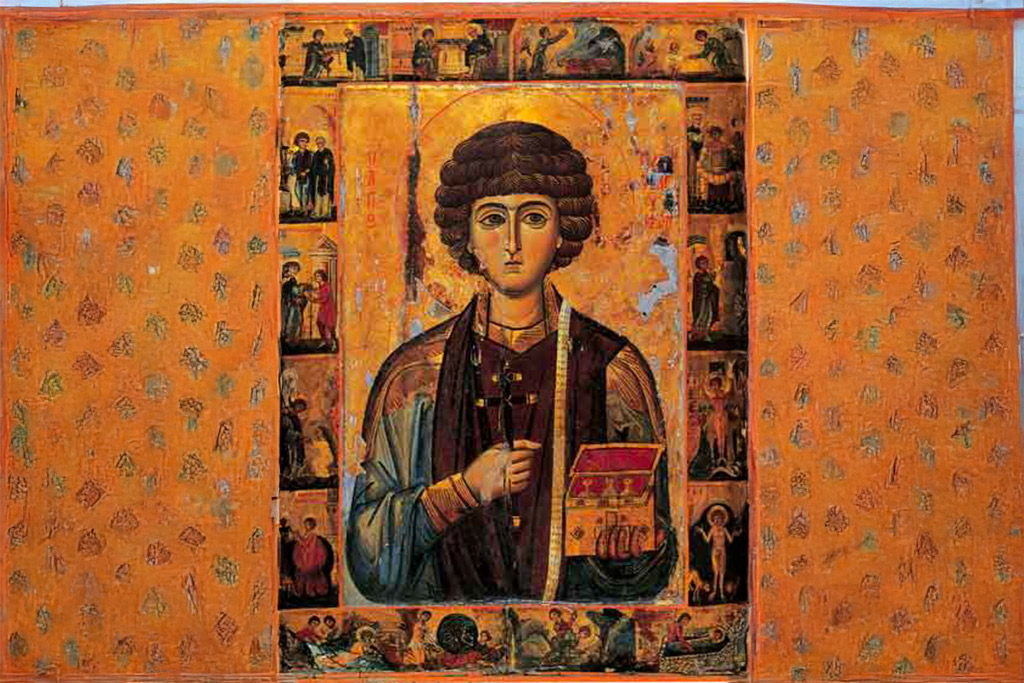

He Who Has Compassion for All
Saint Pantaleon, also known as Saint Pantalon, is one of the most well-known martyrs of the Great Persecution against Christians under the Roman Empire (303–305 AD). He is venerated as the Patron Saint of midwives and, together with Saints Cosmas and Damian, is a co-patron of physicians. He belongs to the group of anargyroi saints—those who offered medical care free of charge, without accepting any payment (from the Greek: “without silver”).
According to hagiographic tradition, passed down in many languages and versions since ancient times, Pantaleon was born in Nicomedia (in present-day Turkey) to Eustorgius, a wealthy pagan, and Eubula, a Christian who raised him in the faith. After his mother’s death, he drifted away from the Church and devoted himself to the study of medicine under his teacher Euphrosynus, becoming so skilled that he was eventually called to serve the emperor Maximian—or, more likely, Galerius.
His return to the Christian faith came through his encounter with a priest named Hermolaus, who was living in hiding to escape persecution. Moved by Pantaleon’s medical abilities, Hermolaus urged him not to neglect the “science of salvation.” Deeply touched, Pantaleon experienced a profound conversion and, invoking the name of Christ, miraculously healed a blind man—an event that also led to his father’s conversion. After his father’s death, Pantaleon freed his slaves and gave away his wealth to the poor.
The jealousy of other physicians led to his being denounced to the emperor, who tried various means to make him renounce Christ. But Pantaleon remained steadfast in his faith. He was sentenced to death, and his miracles were labeled “magic.” According to the Passio, he survived multiple execution attempts until he willingly accepted death, forgiving his persecutors. Tradition holds that a voice from heaven called him “Panteleimon,” meaning “the all-compassionate one.”
Despite the legendary elements in his hagiography, the veneration of Saint Pantaleon is very ancient. It is documented by Theodoret of Cyrrhus (4th–5th century) and Procopius of Caesarea (5th–6th century), as well as by the Martyrologium Hieronymianum, which dates back to the 5th century and is based on even older texts.
In Italy, one of the most well-known places associated with the saint is the Cathedral of Ravello, where a vial of his blood is preserved and is said to liquefy every year. Venice has also venerated Saint Pantaleon since the Middle Ages; the Church of San Pantalon preserves one of his arms.