


September 17: Saint Robert Bellarmine, Doctor of the Church
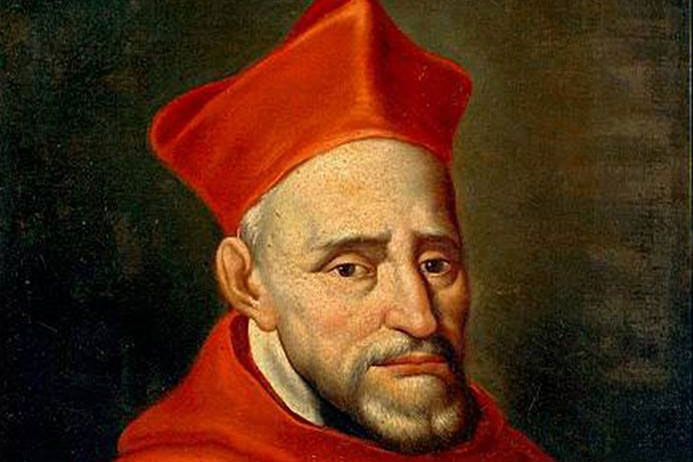

“The Jesuit Clad in Red”
Saint Robert Bellarmine was born on October 4, 1542, in Montepulciano. He came from a large family—the third of twelve children—and his mother was the sister of Cardinal Marcello Cervini, who became Pope Marcellus II in 1555, although his pontificate lasted only twenty-one days.
From an early age, Bellarmine showed great intelligence and a clear religious vocation. His father, who had hoped he would become a physician, initially considered sending him to study in Padua, but eventually accepted his decision to join the Society of Jesus. He began his religious formation in 1560, together with his cousin Roberto Cervini, entering the Jesuit house in Rome. He pursued his studies with great success, moving first to Florence, then Mondovì, Padua, and finally Leuven, where he distinguished himself as a preacher and teacher.
He was ordained a priest in 1570 and took his solemn vows in 1572. Returning to Italy in 1576, he dedicated himself to teaching and to writing important theological works. Among these, the Disputationes de Controversiis Christianae Fidei stands out—a vast work in which he brilliantly synthesized the theology of the Council of Trent.
In 1589, he was chosen as theologian and adviser to Cardinal Caetani, though this mission was cut short by the death of Pope Sixtus V. Nevertheless, he continued to serve the subsequent popes—Gregory XIV, Innocent IX, and Clement VIII—holding important positions in the Roman Curia.
From 1592 to 1595 he was rector of the Roman College, contributing to the drafting of the Ratio Studiorum, the educational plan for Jesuit schools. During those years he was also the spiritual director of Saint Aloysius Gonzaga, whom he accompanied with fatherly devotion until his death.
In 1595 he was appointed Provincial of the Jesuits in Naples and upon his return to Rome, on March 3, 1599, Clement VIII created him Cardinal, with the title of Santa Maria in Via. He also assumed important responsibilities as consultor to the Congregation of the Index and the Holy Office, as well as theologian of the Apostolic Penitentiary. In this period he also wrote a catechism, confirming his commitment to educating in the Christian faith. Despite his high rank, he maintained a sober and modest lifestyle, earning the nickname “The Jesuit Clad in Red.”
In 1602 he was appointed Archbishop of Capua, a position he fulfilled with pastoral zeal until 1605. He was a bishop attentive to and close to his flock. During the 1605 conclave, he was considered among the candidates for the papacy, but Paul V was elected instead; Bellarmine collaborated actively with him on many doctrinal matters.
Two well-known episodes saw him involved: the case of Giordano Bruno, with whom he spoke in prison before Bruno’s condemnation for heresy—though he did not take part directly in the trial—and the matter of Galileo Galilei, to whom Bellarmine communicated the judgment of the Inquisition. Galileo preserved the Cardinal’s letter with respect.
Bellarmine also wrote spiritual and ascetical works, inspired by Saint Bonaventure. Aware of his approaching death, Saint Robert asked for and obtained from the Pope permission to retire to the Jesuit novitiate at Sant’Andrea al Quirinale. There, on September 17, 1621, he died reciting the Creed and invoking the Lord.
His canonization process lasted centuries: he was beatified in 1923, canonized in 1930, and proclaimed Doctor of the Church in 1931 by Pope Pius XI.